
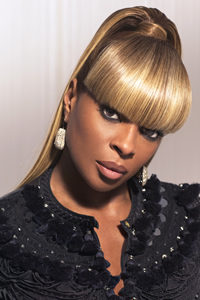
I know who I am and what I can do. With each album, it’s just me continuing to grow.
Pure, unadulterated and empowering: that has been Mary J. Blige’s calling card since her 1992 multi-platinum debut album, What’s the 411? In the ensuing years, the singer-songwriter’s musical strength attracted an intensely loyal fan base responsible for worldwide sales of more than 50 million albums.
With eight multi-platinum albums, nine Grammy Awards, 29 Grammy nominations, a 2012 Golden Globe nomination and four American Music Awards, Blige was only getting started. She returned as fierce and compelling as ever on her tenth studio album, the aptly titled My Life II… The Journey Continues (Act 1). Released through Blige’s Geffen/Interscope-distributed Matriarch label, the project served as the sequel to her 1994 classic My Life.
The original My Life started a movement,
Blige reflected. Every album since then, from Share My World and No More Drama to The Breakthrough and Stronger with Each Tear, has marked a point of growth and evolution for me and my fans. What’s consistent is the fact that we all remain challenged in life to get to that next level. That’s one of the reasons for this sequel. Given the climate right now—the recession, war and other issues—I remembered there was so much healing with the first My Life. So that was another perspective behind my recording the album.
Blige once again fashioned a moving testimony about love, devotion and inner strength. Providing the album’s cornerstone was “Living Proof,” also the closing song for the hit movie The Help. The spare yet powerful recording spoke volumes about life’s hard-won rewards and earned Blige a Golden Globe nomination. It also resonated with her growth as a woman and singer-songwriter whose innate connection with her fans remained unshakable.
My fans and I are living examples that you can turn a negative situation into something positive,
Blige declared. Conceptually, people have heard me like this. But artistically, with just a guitar, I don’t think they’ve ever heard me like that before.
Blige’s artistic growth did not stop there. She went toe to toe with Drake on the uptempo chart-climber “Mr. Wrong,” then displayed fervor and naked honesty on “25/8” and “No Condition.” She tapped her rap alter ego Brook Lynn for the romance-inspired “Midnight Drive.” As she had done in 1993 with the 1975 Rufus featuring Chaka Khan hit “Sweet Thing,” Blige brought new meaning to a dance-floor version of the group’s 1983 classic “Ain’t Nobody.” Guest appearances from Nas, Busta Rhymes and Rick Ross rounded out the project, alongside a first-time pairing with Beyoncé on “Love a Woman.”
A lot of women are misunderstood and a lot of men think they know what to do. But they don’t,
Blige said with a laugh. This overall topic is very important right now.
To help map out the Life journey, Blige collaborated with producers including Jim Jonsin, Rico Love, Jerry “Wonda” Duplessis, Danja, Rodney “Darkchild” Jerkins, Sean Garrett, Tricky Stewart and the Underdogs. Whoever has the right track that grabs my spirit, moves me and goes with the topics I’m coming up with—those are the producers I go for,
she said of her creative process.
Born in the Bronx, New York, Blige began moving people with her soulful voice when, at age 18, she signed with Andre Harrell’s Uptown Records in 1989, becoming the MCA-distributed label’s youngest and first female artist. Influenced from an early age by Aretha Franklin, Chaka Khan and Gladys Knight, Blige brought her own gritty, urban-rooted style—fusing hip-hop, soul and frank, honest lyrics—to the forefront on her 1992 debut album, What’s the 411? Executive-produced by Sean “Diddy” Combs, the multi-platinum set produced several hits, including the number-one R&B singles “You Remind Me” and “Real Love.”
Earning the nickname “Queen of Hip-Hop Soul,” Blige began forging a unique niche on the more personal second album, 1994’s My Life. Co-writing much of the album, she produced hits and signature songs including “Be Happy” and a cover of Rose Royce’s 1976 hit “I’m Goin’ Down.” At the time, she was dealing with serious issues including drug addiction, alcoholism and an abusive relationship.
When I first went into the studio to work on My Life II, it occurred to me how strong I’ve become since then,
Blige noted. What has made me strong is not just the joy and great things happening in my life, but the trials and difficulties that cause you to want to move out of that uncomfortable place to get to the next stage. With the first My Life album, I didn’t have that understanding. I just did not know why I was suffering so badly, why I was hurting.
And so began the Blige movement, connecting legions of fans who identified with and accompanied her through personal struggles and growth, all fearlessly related through her music. Each subsequent album read like a chapter from an autobiography: Share My World (1997), Mary (1999), No More Drama (2001), Love & Life (2003), the multiple Grammy-winning The Breakthrough (2005), Growing Pains (2007) and Stronger with Each Tear (2009). Along the way, she recorded a string of hit singles including “Not Gon’ Cry,” “Love Is All We Need,” “Seven Days,” “All That I Can Say,” “Family Affair” and “Just Fine.”
Blige, who co-wrote “I Can See in Color” for the 2009 Precious soundtrack, also expanded her acting career. She appeared in Adam Shankman’s Rock of Ages, the theatrical version of the Tony-nominated Broadway musical, alongside Tom Cruise, Alec Baldwin and Catherine Zeta-Jones. In 2013, Blige was scheduled to star as Betty Shabazz in Betty & Coretta on Lifetime.
As she continued her multifaceted journey, one constant remained: her fans. Being connected with their lives is what keeps me going,
she said. They’re the reason why I am where I am—confident in knowing who I am and what I can do. With each album, it’s just me continuing to grow. That’s the takeaway I want for my fans with My Life II: to please look at what we’ve survived and how strong we are now.
This biography and photograph were reproduced from the Jamaica Jazz & Blues Media Press Kit.